
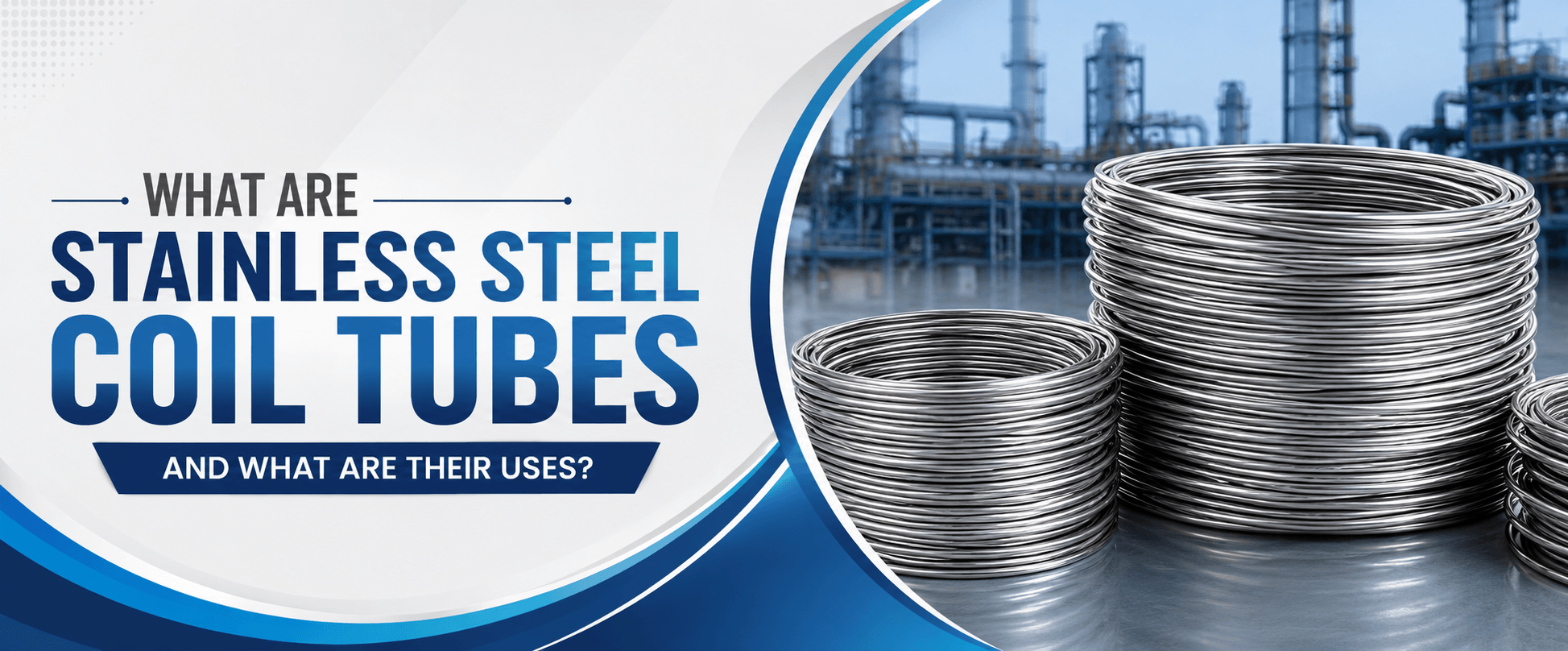
Industrial manufacturing, petrochemicals, pharmaceuticals, or any industry where fluid or gas needs to travel through a system reliably and safely, stainless steel coil tubes shape the process. In this process, let’s explore more about ss coil tubes, how they differ from straight tubes, and which applications they are genuinely best suited for.
What are Stainless Steel Coil Tubes?
Stainless steel coil tubes are seamless or welded stainless steel tubes that have been precision-wound into a continuous coil form during or after manufacture. Rather than being cut and supplied in straight lengths, coil tubes are produced and delivered as long continuous lengths wound onto a reel or formed into a self-supporting coil.
The coiling process allows a single continuous length of tube to occupy a compact design while offering far greater run length than straight tube sections. Depending on the application, coil tubes are available in a wide range of outer diameters, wall thicknesses, and coil diameters and can be manufactured from multiple stainless steel grades, including 304, 304L, 316, 316L, 321, and duplex grades for more demanding corrosion environments.
At Arya Tubes, SS coil tubes are manufactured by cold drawing and are preferred for high-pressure applications, precision instrumentation, and anywhere that absolute integrity of the tube wall is critical. Welded and drawn coil ss tubes offer a cost-effective alternative for lower-pressure fluid transfer and general process applications. Welded, drawn, and annealed (WDA) stainless steel coil tubing is also suitable for critical applications.
How are SS Coil Tubes Different from Straight Tubes?
The fundamental difference is form, not material. The stainless steel grade, wall thickness, and surface finish can be identical. What changes is the geometry of supply and, consequently, the range of applications the tube is suited for.
SS coil tubes eliminate the need for intermediate joints across long continuous runs. A single coiled length can serve as a heat exchanger, a cooling loop, or an instrumentation line without a single intermediate connection. For manufacturers who specify tubing for high-integrity systems, that is a meaningful advantage.
SS tubes require joints, fittings, or welds every time the run changes direction or exceeds the cut length. Every joint is a potential leak point. In critical process systems where fluid purity, containment, or pressure integrity matters, reducing the number of joints in a system reduces risk.
Where are Stainless Steel Coil Tubes Used?
1. Heat Exchangers
This is one of the most common and demanding applications for stainless steel tube coils. In heat exchanger design, the coiled tube geometry increases surface area in contact with the surrounding medium within a compact vessel, improving thermal transfer efficiency without increasing the size of the unit.
Stainless steel tube coils for heat exchangers are used across the chemical processing, power generation, HVAC, food and beverage, and pharmaceutical industries. The grade selected depends on the process fluid and temperature: 316L is the standard choice for corrosive media, while 321 is preferred for high-temperature applications.
2. Fluid Transfer Systems
Stainless steel tubing for fluid transfer is a primary application for coil tube across process industries. Wherever a fluid, liquid, or gas needs to travel continuously through a system with minimal joints and maximum reliability, coil tube is the preferred supply format.
Hydraulic systems, chemical dosing lines, sampling lines, and cryogenic transfer systems all use SS coil tubes for exactly this reason. The continuous length minimises leak risk, and the stainless steel construction resists corrosion from the media being transferred.
3. Instrumentation and Control Lines
Precision instrumentation tubing is one of the most exacting applications for seamless stainless steel coil tubes. Pressure measurement lines, pneumatic control circuits, analyser sample lines, and impulse lines connecting instruments to process connections all require tubing with consistent bore dimensions, smooth internal surfaces, and absolute wall integrity. Coil tube is the standard supply format for instrumentation tubing because it allows field engineers to run exactly the length they need from a single reel without intermediate joints.
4. Refrigeration and Cooling Systems
Stainless steel coil tubes are used in refrigeration circuits, chiller coils, and cooling loops across the food processing, pharmaceutical, and industrial sectors. The coiled geometry of the tube serves double duty here: it provides the compact, high-surface-area configuration the cooling system needs while also allowing thermal expansion and contraction across temperature cycles without stressing the tube wall.
5. Petrochemical and Oil and Gas Applications
In upstream and downstream oil and gas processing, SS coil tubes are used in impulse lines, chemical injection lines, hydraulic control umbilicals, and heat tracing applications. The combination of corrosion resistance, pressure capability, and continuous-length supply makes stainless steel coil tube a natural specification choice in these environments. Grade selection, such as 316L for standard service, duplex for more aggressive conditions, is determined by the specific process environment.
6. Pharmaceutical and Food Processing
Hygienic process design demands tube systems with smooth internal bores, minimal joints, and full traceability of material. Stainless steel coil tubes in 316L grade with electropolished internal surfaces are used in clean-in-place (CIP) circuits, product transfer lines, and heat exchanger coils within pharmaceutical manufacturing and food processing plants.
What to Look for in a SS Coil Tubes Manufacturer or Supplier
Not all stainless steel coil tube suppliers offer the same level of product quality or technical support. When evaluating a manufacturer, the key considerations are:
- Dimensional consistency: Bore diameter, wall thickness, and outer diameter tolerances must be consistent across the full coil length. Variation in wall thickness is a particular concern in high-pressure and precision instrumentation applications.
- Surface finish: Internal surface finish affects both flow characteristics and cleanability. Confirm the internal Ra value meets your process requirement.
- Packaging & Storing: Reel diameter, coil weight, and packaging format affect how the tube is handled and stored on site. A good stainless steel coil tube supplier will work with your logistics and installation requirements, not just their own production convenience.
As an experienced SS coil tubes manufacturer, Arya Tubes supplies industrial customers across heat exchange, fluid transfer, instrumentation, and process applications. We manufacture to international standards, ISO and BIS certified with full material traceability and documentation.
If you have a coil tube requirement, share your specification with our technical team — OD, wall thickness, grade, coil length, and end-use application and we will come back with a detailed technical and commercial proposal.
FAQs
Q1. What is the difference between seamless and welded stainless steel coil tubes?
A. Seamless SS coil tubes are cold-drawn from solid billets with no weld seam, making them ideal for high-pressure and precision instrumentation applications. Welded and drawn coil tubes are cost-effective for moderate-pressure fluid transfer where seamless-grade integrity is not required.
Q2. What stainless steel grades are available for coil tubes?
A. Grades 304 and 304L suit general-purpose applications. Grade 316L adds molybdenum for superior chloride and corrosion resistance in chemical and pharmaceutical environments. Grade 321 handles elevated temperatures, while duplex grades are specified for aggressive oil and gas service conditions.
Q3. What standards do stainless steel coil tubes comply with?
A. Common standards include ASTM A269 for general instrumentation and fluid transfer, ASTM A213 for heat exchanger applications, and EN 10216-5 for European pressure service. Pharmaceutical and food processing applications may require additional surface finish, traceability, and third-party inspection documentation.
Q4. What coil lengths are available for stainless steel tubing?
A. Coil lengths typically range from 30 to 250 metres per reel, depending on outer diameter and wall thickness. Smaller diameter instrumentation tubing is available in longer continuous lengths. Custom coil lengths, reel weights, and coil dimensions are available on request.
Q5. How should stainless steel coil tubes be stored on site?
A. Store coils under cover, away from carbon steel and grinding operations to prevent iron contamination. Keep end caps in place until installation. Handle with clean gloves or non-metallic equipment. For hygienic applications, flush internally with demineralised water before connecting to the system.
Related Blogs:
Why Industries Prefer Welded Drawn & Annealed SS Tubes
Medical Grade Stainless Steel Tubing: Requirements, Standards & Use Cases