
If you specify stainless steel tubing for critical industrial applications, you have almost certainly come across the term annealed. It appears on mill test certificates, in material specifications, and across procurement documents. But what does it actually mean for the tube you receive, and why should it matter to your engineering or procurement team?
As a stainless steel tube manufacturer supplying industrial customers across sectors ranging from pharmaceuticals to oil and gas, we often get this question. This blog clearly breaks down the annealing process, explains what it changes in the material, and tells you when and why annealed stainless steel tubes belong in your application.
What is Annealing?
Annealing is a controlled heat treatment of stainless steel tubes in which the tube is heated to a precise high temperature and then cooled under controlled conditions. For austenitic grades like 304 and 316, the typical annealing temperature range sits between 1010°C and 1120°C. The tube is held at that temperature long enough for the microstructure to fully transform, then cooled rapidly enough to prevent the precipitation of chromium carbides at grain boundaries, a phenomenon known as sensitisation.
In plain terms, the heat treatment of stainless steel tubes through annealing achieves three things simultaneously: it relieves internal stress built up during forming and welding, it restores ductility lost during cold working, and it resets the microstructure to give the material its full corrosion resistance.
Why Does Stainless Steel Need Annealing After Forming?
To understand why annealing matters, you need to understand what forming and welding do to the material.
When a stainless steel tube is cold drawn, the metal is worked mechanically. This cold-drawing increases hardness and tensile strength but introduces significant residual stress into the tube wall and causes work hardening that reduces ductility. A tube in this condition is dimensionally accurate but internally stressed and less formable.
When a tube is welded, the heat of the weld creates a heat-affected zone where the microstructure changes. In sensitised zones, chromium migrates to grain boundaries to form chromium carbides, leaving the surrounding metal chromium-depleted and therefore vulnerable to intergranular corrosion.
Both conditions, cold-worked stress and weld sensitisation, compromise the tube’s long-term performance in demanding environments. Annealing corrects both.
Drawn and Annealed vs Welded and Annealed: Understanding the Difference
The two most common tube types your specification will encounter are drawn and annealed stainless steel tubes and welded and annealed stainless steel tubes, and the distinction is meaningful.
Drawn and annealed stainless steel tubes begin as seamless or welded mother tubes that are cold drawn through a die to achieve precise outer diameter and wall thickness tolerances. The drawing process work-hardens the material. Annealing is used to restore mechanical properties and ductility, making these tubes suitable for applications requiring tight dimensional tolerances alongside good formability and fatigue resistance.
Welded, drawn, annealed SS tubes follow a route where a strip of stainless steel is formed into a tube and longitudinally welded, then cold drawn and annealed. This route offers consistent dimensions and surface finish at a competitive cost for a wide range of industrial applications. The combination of drawing and annealing eliminates the weld seam’s mechanical inferiority and homogenises the entire tube cross-section.
Welded and annealed stainless steel tubes, without the drawing step, are produced by welding and annealing alone. These are suitable for lower-pressure or structural applications where the tightest dimensional tolerances are not required, but corrosion resistance and material consistency are still critical.
Bright Annealing: A Higher Standard for Demanding Applications
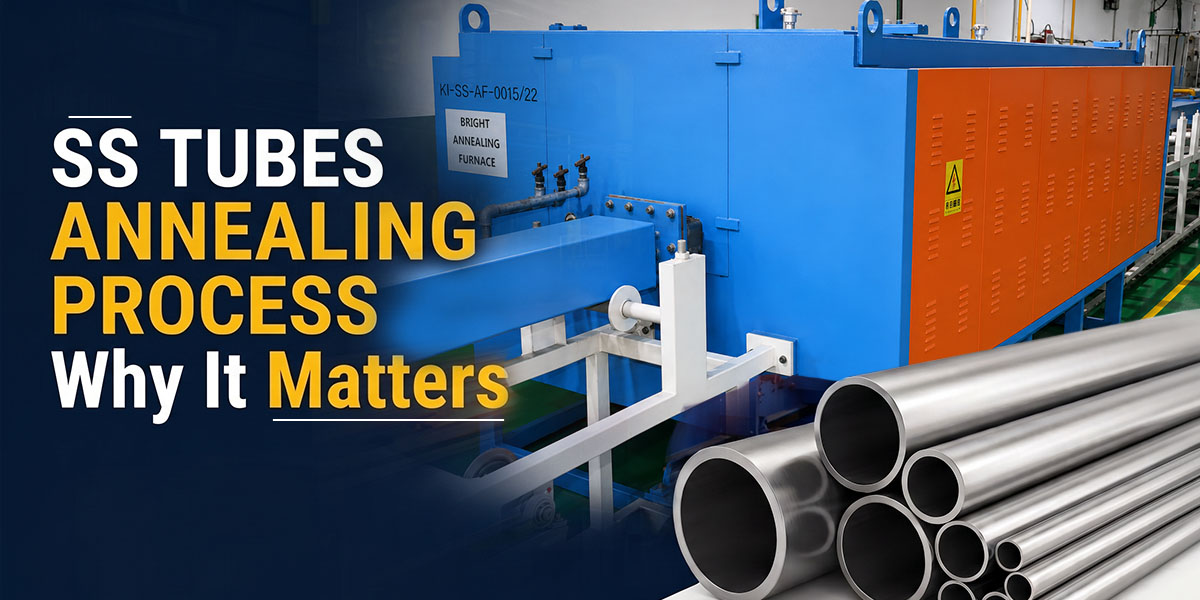
For industries where surface quality is non-negotiable, bright annealed stainless steel tubes represent the benchmark. In a standard annealing furnace with an atmospheric environment, the tube surface oxidises and requires subsequent pickling and passivation to restore corrosion resistance. This adds process steps and can introduce surface variability.
Bright annealing is performed in a controlled atmosphere furnace, typically under a hydrogen or nitrogen-hydrogen mix, which prevents oxidation entirely. The result is a tube with a clean, smooth, bright interior and exterior surface directly out of the furnace, with no scale, no oxide layer, and no need for acid pickling.
For pharmaceutical manufacturing, food processing, semiconductor fabrication, and high-purity fluid handling, bright annealed tubes are not a premium option but a specification requirement. The smooth, oxide-free surface resists bacterial adhesion, supports cleanability, and eliminates contamination risk from residual pickling chemistry.
What Annealing Does to Mechanical and Corrosion Properties
The practical outcomes of annealing that matter to your engineers are straightforward.
- Yield strength and hardness reduce from their cold-worked peaks to values consistent with the annealed condition listed in ASTM or EN standards. For 316L drawn and annealed tube, this typically means yield strength in the range of 170 to 310 MPa and elongation values above 35 percent, giving fabricators the formability needed for bending, flaring, and orbital welding.
- Corrosion resistance, the defining property of corrosion-resistant tubing, is fully restored. By dissolving chromium carbides and redistributing chromium uniformly through the matrix, annealing ensures the passive chromium oxide layer that protects stainless steel forms evenly across the entire tube surface, including through and around the weld zone.
- Residual stress, which can drive stress corrosion cracking in chloride-rich or high-temperature environments, is substantially reduced. For applications in chemical processing, offshore installations, and heat exchangers, this stress relief translates directly into longer service life.
How Annealing Fits Into the Stainless Steel Tube Manufacturing Process
At the Arya Tubes manufacturing facility, annealing is not an afterthought; it is a designed step within the stainless steel tube manufacturing process, with temperature, atmosphere, time at temperature, and cooling rate controlled and documented for every production run.
SS tubes are tracked through the furnace with thermocouple verification. Post-anneal hardness testing, tensile sampling, and, where specified, intergranular corrosion testing. For ss annealed tubes supplied to critical applications, this traceability matters as much as the material grade itself.
For drawn and annealed, welded and annealed, and bright annealed SS tubes to ASTM, EN, and customer-specific standards for industrial applications worldwide, connect with Arya Tubes. If you have a technical requirement or a specification you would like to discuss, our engineering team is ready to help.