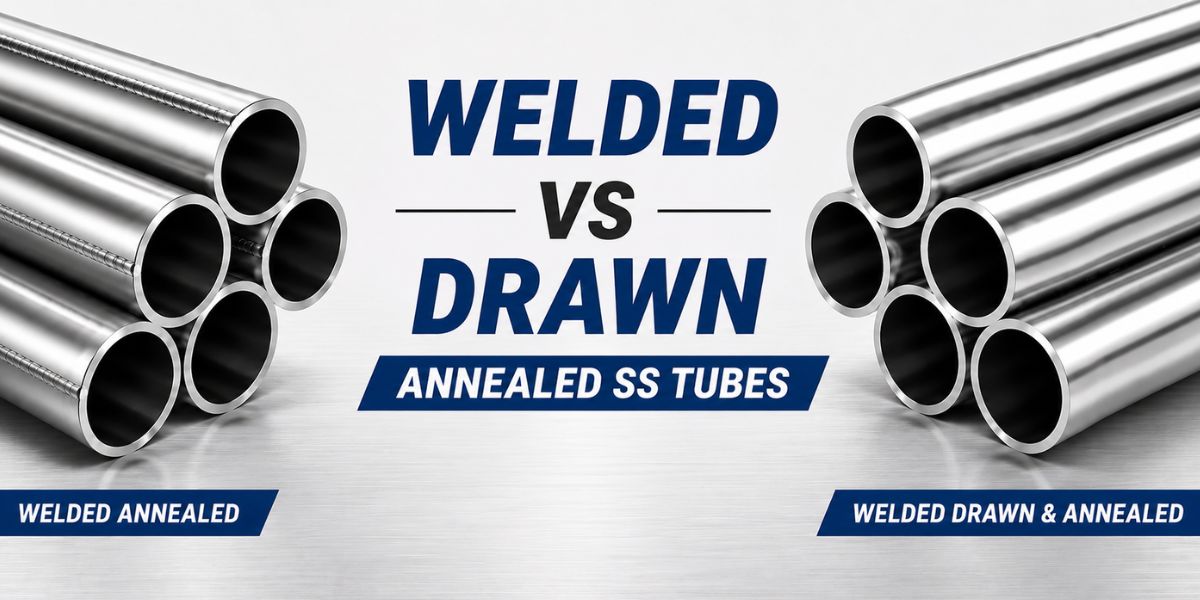
Welded, drawn and annealed stainless steel tubes, or WDA, show up on spec sheets, supplier catalogues, and procurement documents across industries. But what does it actually mean, why does the process matter, and why do engineers and purchasing managers keep coming back to it when precision is on the line? Here is a straightforward answer to all of that.
Welded, drawn and annealed SS tubes are specialized for a few industrial purposes
What are Welded, Drawn and Annealed Stainless Steel Tubes?
The name describes the three-stage manufacturing process the ss tube goes through, and each stage matters.
1. Welding – It starts as a welded tube. A flat strip of stainless steel is roll-formed into a tube shape and joined along a longitudinal seam using TIG welding in a chemically neutral environment. This ensures a clean, consistently formed tube with a controlled weld line.
2. Drawing – The tube is then drawn. It is pulled through a series of precision dies, with or without an internal mandrel, to progressively reduce both its outer diameter and wall thickness. This drawing process is where the dimensional accuracy happens. Each pass through the die tightens the tolerances and refines the surface finish. Between drawing passes, the tube is annealed to restore ductility before the next reduction.
3. Annealing – That brings us to annealing. The finished tube is heated to around 1040°C in a controlled furnace environment and then cooled. This does several things at once: it relieves the internal stresses built up during cold working and drawing, recrystallises the work-hardened grain structure, and homogenises the weld zone, which is where pitting corrosion typically starts if left untreated. The result is a tube with mechanical properties close to seamless, at a cost that works for volume production.
The final product, a welded drawn and annealed stainless steel tube, has an exceptionally uniform wall thickness, a smooth internal bore, tight dimensional tolerances, and a surface finish that requires little or no further processing for most applications.
Why This Matters to the Industries That Use SS Tubes
A basic welded tube is fine for many applications. But once you need thin walls, close tolerances, consistent internal bore dimensions, or the tube is going into a bend, flare, or forming operation, the WDA process starts earning its place on the spec sheet.
Here is what that looks like in practice across the industries that rely on these tubes most.
Refrigeration and HVAC: G-coil assemblies and refrigerant line components need to be bent repeatedly without cracking or losing their circular cross-section. The drawing and annealing process gives the tube the ductility to handle tight radius bending and the wall uniformity to maintain consistent flow characteristics through the coil. Arya Tubes’ WDA stainless steel range is specifically suited for ss G-coil assemblies and reducers where both formability and dimensional consistency are non-negotiable.
Automotive and fluid systems: High-pressure hydraulic and brake lines, fuel delivery components, and fluid connectors all require tubing that can withstand both pressure and vibration over long service cycles. High-strength stainless steel tubes in ASTM 304 and 316L grades, processed through drawing and annealing, provide the tensile properties and fatigue resistance these applications demand.
Medical and instrumentation: Thin wall annealed stainless steel tubes are used in surgical instruments, diagnostic equipment, and fluid handling assemblies where precise outer diameters and bore dimensions are structurally critical. A 0.10mm wall with any eccentricity is simply not acceptable in medical instrumentation, which is why drawn and annealed tubes are the industry default for these applications.
Food processing and pharmaceuticals: Corrosion resistance is not optional in these environments. The annealing step, by relieving weld-induced stresses and homogenising the heat-affected zone, significantly improves pitting resistance compared to a tube that has been welded and left as-is. ASTM 316L stainless steel tubes, with their added molybdenum content, paired with proper annealing, give you a tube that holds up in chloride-rich and chemically aggressive processing environments.
Also Read: How to Prevent Corrosion in Steel Tubes: Expert Tips
Industrial and OEM manufacturing: Connectors, reducers, and custom-formed components across general manufacturing benefit from the consistency WDA tubing offers. When a tube needs to be machined, threaded, welded, or formed at the next stage of production, uniform wall thickness and predictable mechanical properties reduce scrap rates and rework.
The Specific Benefits Worth Knowing
To put it plainly, here is what the WDA process delivers that a standard welded tube cannot:
- Dimensional accuracy: Drawing through precision dies produces outer diameter tolerances and wall thickness uniformity that are not achievable through the welding and annealing process alone. For thin wall stainless steel tube manufacturing, this matters enormously.
- Superior corrosion resistance: The annealing process dissolves chromium carbides that form during welding, restoring the chromium available at the surface to do its passivation work. The result is corrosion-resistant stainless steel tubing that behaves consistently across the whole tube, not just away from the weld seam.
- Improved ductility and formability: Work-hardened tube is brittle and prone to cracking during bending or flaring operations. Annealing brings the ductility back, so the tube can be formed without failure.
- Smooth internal bore: The drawing process and controlled finish leave an internal surface that supports clean fluid flow, reduces contamination risk, and meets the surface finish requirements for pharmaceutical and food-grade applications.
- Cost efficiency relative to seamless: Welded, drawn, and annealed tubes achieve mechanical properties close to seamless equivalents while typically carrying a more competitive price point and shorter lead times, because the starting stock is strip rather than billet.
ASTM 304 and 316L: The Two Grades That Cover Most Applications
The majority of WDA stainless steel tubes in industrial use are produced in ASTM 304 or ASTM 316L stainless steel, and for good reason.
ASTM 304 annealed tubes are the workhorse of the range. The 18% chromium and 8% nickel composition gives strong corrosion resistance across a wide range of environments, good formability, and reliable mechanical properties at a cost-effective price. Most HVAC, automotive, and general industrial applications are well served by 304.
ASTM 316L adds molybdenum, which directly improves resistance to pitting and crevice corrosion in chloride environments. If your application involves seawater, chemical processing, pharmaceutical fluids, or aggressive cleaning agents, 316L is the specification to reach for. The low carbon content of 316L also reduces sensitisation risk in welded assemblies, which matters when the tube will be further welded at the fabrication stage.
At Arya Tubes, both grades are manufactured to international standards and are available across the full range of diameters and wall thicknesses in the WDA stainless steel tubes product line.
Also Read: Common Grades of Stainless Steel Tubes Explained
The Bottom Line
Welded, drawn and annealed stainless steel tubes are not a premium specification for its own sake. They exist because a long list of industrial applications genuinely need the dimensional accuracy, corrosion resistance, surface finish, and formability that the WDA process delivers, at a cost point that makes volume procurement practical.
If your next project calls for precision ss tubes in ASTM 304 or 316L, thin-wall sections, or components that will be bent or formed after delivery, WDA tubing is worth specifying from the start rather than discovering its advantages after a standard welded tube falls short.
Arya Tubes’ manufacturers, supplies and exports welded, drawn and annealed stainless steel tubes in customized sizes and dimensions.