
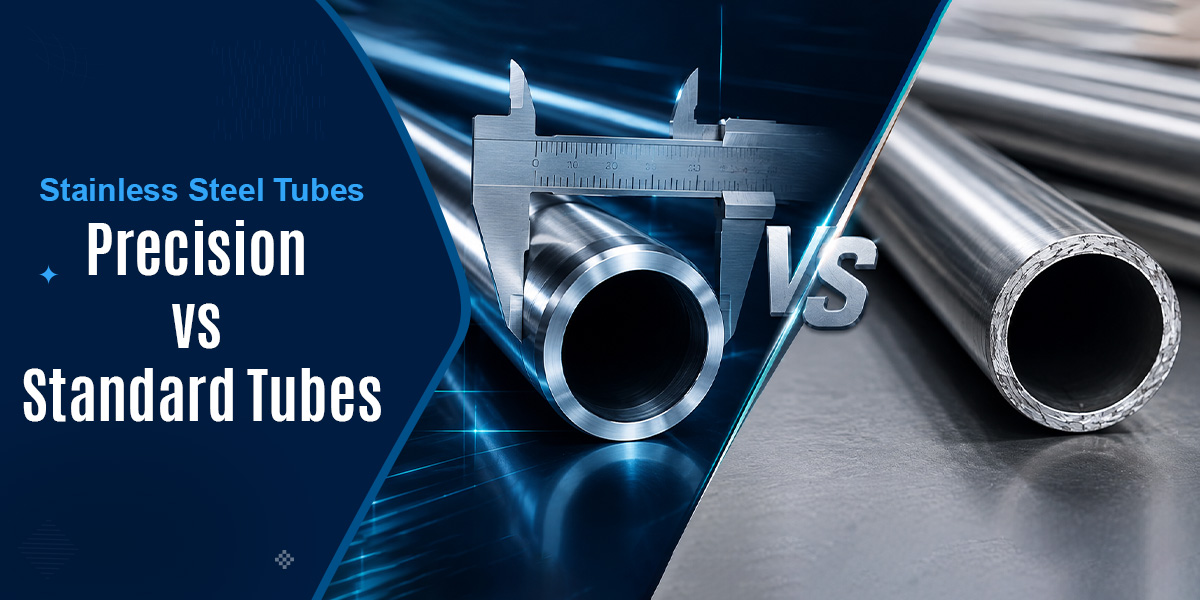
Manufacturers understand the requirements of equipment where a fraction of a millimeter matters- a surgical device, a heater element, a fuel line, a heat exchanger- you already know that not all stainless steel tubing is built the same way. Precision stainless steel tubes and standard stainless steel tubes may look similar on a shelf, but the way they’re made, measured, and finished puts them in entirely different performance categories.
This blog, will cover:
- Standard Stainless Steel Tubing: Built for General Use
- Precision Stainless Steel Tubes: Built for Exactness
- Key Differences – Precision Stainless Steel Tubes & Standard Tubes
- Precision Tube OD and Wall Thickness Range
- Benefits of Precision Stainless Steel Tubes
- Precision Tubing Applications
- When to Use Precision Stainless Steel Tubes
Welded SS tubes, welded-drawn stainless steel tubing, or welded-drawn annealed tubes- the question is: what separates precision tubing from the standard stuff, and how do you know which one your application needs? Here’s the breakdown.
Standard Stainless Steel Tubing: Built for General Use
Standard stainless steel tubing is manufactured to relatively wide dimensional tolerances. It’s produced at high volume, meets general structural or fluid-carrying requirements, and works well for applications like handrails, general fabrication, furniture framing, or basic tubes where exact OD, ID, or wall thickness isn’t mission-critical.
Standard tubes can vary slightly from length to length, batch to batch. For low-stakes applications, that’s perfectly fine. For precision-engineered equipment, it isn’t.
Precision Stainless Steel Tubes: Built for Exactness
Precision tubing is manufactured to tight, often micron-level tolerances across several key dimensions:
- Outer diameter (OD)
- Inner diameter (ID)
- Wall thickness
- Straightness
- Surface finish
This level of accuracy is typically achieved through cold drawing, a process where welded tube is pulled through a die (or over a mandrel) at room temperature to reduce and control its dimensions with far greater accuracy than hot-forming or standard welding alone can deliver.
Also Read: OD, ID & Wall Thickness Explained for Stainless Steel Tubes
Cold drawn stainless steel tubes gain several advantages directly from this process:
- Dimensional accuracy across every length
- Improved mechanical strength from cold working
- Refined, smoother surface finish
- The ability to produce small-diameter stainless steel tubes and thin-wall stainless steel tubes, geometries that standard manufacturing methods simply can’t hold consistently
At Arya Tubes, our welded, drawn, and annealed product lines are purpose-built for this level of precision, offering stainless steel tubes with superior surface finish, high tensile strength, and enhanced mechanical properties for applications where standard tubing would fall short.
Precision Stainless Steel Tubes vs Standard Tubes: The Key Differences
Factor |
Standard Tubes |
Precision Stainless Steel Tubes |
Dimensional tolerance |
Loose |
Tight (micron-level control) |
Manufacturing process |
Welding only |
Welding + cold drawing (+ annealing) |
Surface finish |
Basic |
Smooth, refined, often mirror-polished |
Wall thickness options |
Limited range |
Extends to thin-wall and capillary sizes |
Typical use |
General fabrication |
Engineered, high-spec systems |
The core precision stainless steel tubes vs standard tubes distinction comes down to control: control over dimensions, control over mechanical properties, and control over repeatability across every single length produced.
Precision Tube OD and Wall Thickness Range
One of the most practical differences shows up in the precision tube OD and wall thickness range a manufacturer can offer. Precision cold-drawn processes allow ss tubes manufacturers to produce small-diameter and capillary tubing with thin walls that maintain strength and roundness, dimensions that standard tube mills aren’t equipped to hold consistently. This makes precision tubing the go-to choice whenever an engineering drawing calls for tight OD/ID/wall specifications rather than a general nominal size.
Benefits of Precision Stainless Steel Tubes
- Dimensional accuracy — consistent OD, ID, and wall thickness across every length
- Improved mechanical strength from the cold-working process
- Superior surface finish, reducing friction and contamination risk
- Design flexibility for small-diameter and thin-wall geometries
- Better weldability and formability in downstream fabrication
- Long-term reliability in demanding or regulated environments
Precision Tubing Applications
Precision tubing applications span nearly every industry that depends on exact performance:
- Medical and pharmaceutical — capillary tubing, surgical instruments, drug-delivery components
- Automotive — fuel lines, sensor housings, hydraulic tubing
- Heating and appliances — immersion rods, geyser elements, industrial heaters
- Instrumentation — pressure and temperature sensor tubes
- Aerospace and defense — lightweight, high-strength structural tubing
- Industrial equipment — heat exchangers, control systems, and fluid-handling assemblies
Also Read: Medical Grade SS Tubing: Requirements, Standards & Use Cases
These are the same sectors we supply as industrial stainless steel tubes manufacturers, primarily in 304 and 316L grades, chosen for their corrosion resistance, strength, and compatibility with sterile or high-temperature environments. Depending on the application, choose stainless grades to match specific mechanical or chemical resistance requirements.
When to Use Precision Stainless Steel Tubes
So, when to use precision stainless steel tubes instead of standard ones? As a general rule:
- Your drawing specifies tight tolerances on OD, ID, or wall thickness
- The application involves small diameters or thin walls
- Surface finish and cleanliness are critical (medical, pharma, food-grade)
- The tube will undergo further forming, bending, or welding
- Consistency across thousands of units is non-negotiable
If any of these apply, standard tubing won’t meet the spec; precision tubing will.
Manufactured for Precision, Trusted Globally
At Arya Tubes, a division of KnitPro International, we manufacture welded, welded-and-annealed, welded-and-drawn, and welded-drawn-and-annealed stainless steel tubes primarily in 304 and 316L grades, built to ISO 9626 standards for both medical and industrial use. With over 30 years of manufacturing experience and production infrastructure, we help engineers and procurement teams across the globe get the exact tube specification their application demands.
Have a project that needs tight tolerances? Get in touch with our team for a quote, or explore our full product range.
Q1. What’s the Difference Between Precision and Standard Stainless Steel Tubes?
A. Precision stainless steel tubes are manufactured to tight, micron-level tolerances for OD, ID, wall thickness, and surface finish. Standard tubes are typically produced to looser tolerances and are more suitable for general fabrication and applications where extremely tight dimensional control is not required.
Q2. How Are Precision Stainless Steel Tubes Made?
A. Precision stainless steel tubing is typically manufactured by cold-drawing welded tube through a die or over a mandrel. This process improves dimensional accuracy, strength, and surface finish compared with standard welded tubing. Some precision tubes are also annealed to enhance their mechanical properties and achieve the required material condition.
Q3. When Should I Use Precision Stainless Steel Tubing?
A. Precision stainless steel tubing is recommended when your application requires tight OD, ID, or wall-thickness tolerances, small diameters or thin walls, a critical surface finish, further forming or welding, or consistent quality across high-volume production runs.
Q4. What Industries Use Precision Stainless Steel Tubes?
A. Precision stainless steel tubing is widely used in medical, pharmaceutical, automotive, aerospace, instrumentation, heating, and industrial equipment applications. Common grades include 304 and 316L stainless steel, selected for their corrosion resistance, strength, durability, and suitability for sterile or high-temperature environments.
Related Blogs:
What are Stainless Steel Coil Tubes and Where are they used?
Choosing Stainless Steel Tubes Manufacturer & Supplier in India – A Complete Buyer’s Guide