
A stainless steel tube spec sheet is like a health report; the grade reveals composition, wall thickness shows resilience, tolerances measure precision, and finish reflects overall condition before it enters service. The three simple measurements need their own vocabulary; you’re not alone. OD, ID, and wall thickness show up on every datasheet, every RFQ, and every technical drawing and getting them right (or wrong) can be the difference between success and failure in industrial applications.
Let’s break down what these terms actually mean and why they matter so much when you’re sourcing stainless steel tubing for medical, heating, automotive, or industrial applications.
What is OD, ID, and Wall Thickness in Stainless Steel Tubes?
OD (Outer Diameter) is the measurement across the outside of the tube. ID (Inner Diameter) is the measurement across the inside bore. Wall thickness is the material between them. In simple terms: OD minus twice the wall thickness equals ID.
ID = OD − (2 × WT)
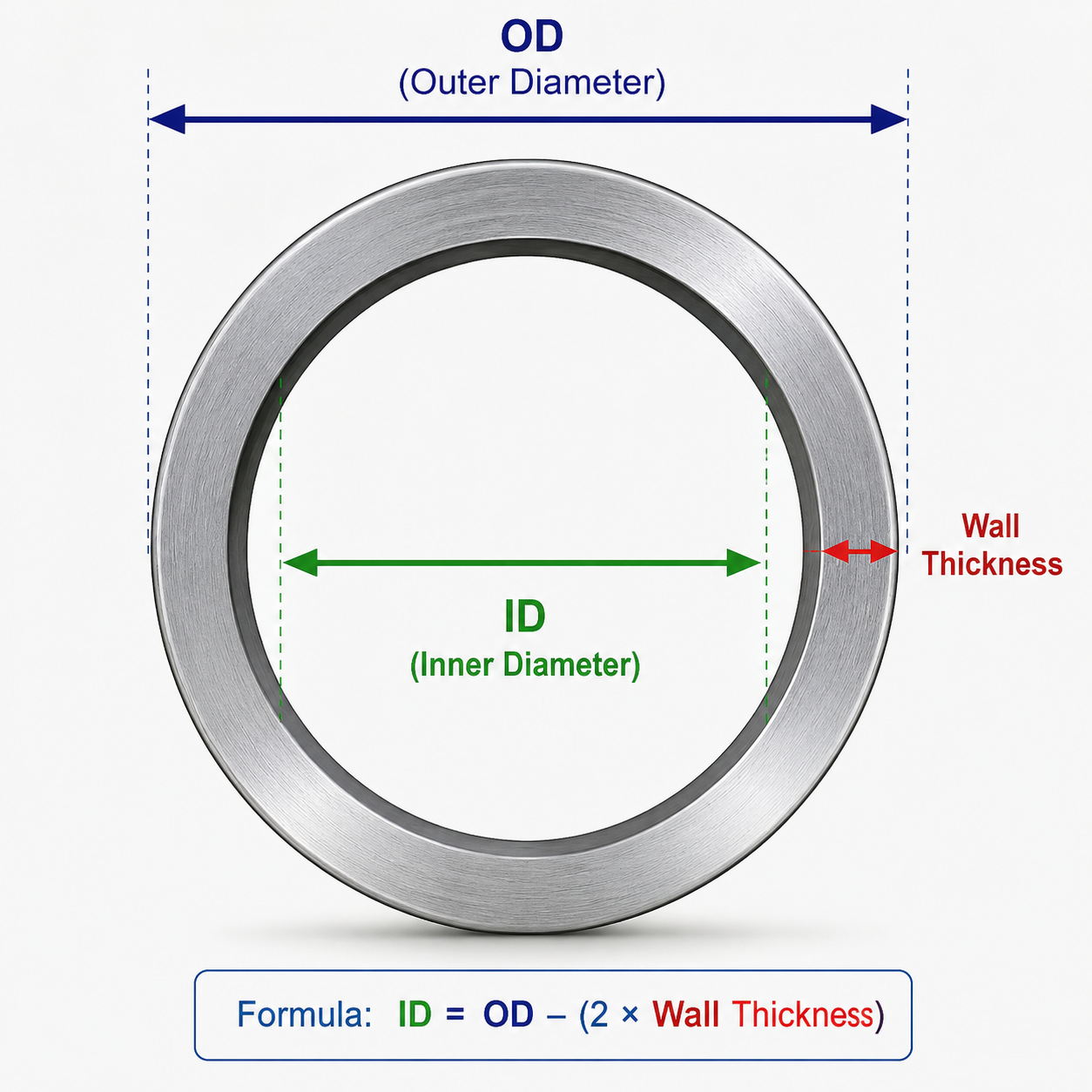
Example: OD = 10 mm, WT = 1 mm
ID = 8 mm
These three numbers, together, define stainless steel tube dimensions and determine how a tube performs under pressure, how it fits with fittings or components, and how much flow or flex it can handle.
Quick Reference Table:
| Term |
Meaning |
Why it Matters |
|
OD |
Outer Diameter |
Determines fitting compatibility |
|
ID |
Inner Diameter |
Controls flow capacity |
|
Wall Thickness (WT) |
Material between OD & ID |
Affects pressure resistance and strength |
Why These Measurements Matter So Much
For OEMs and manufacturers, ss tube dimensions aren’t just numbers on a drawing; they directly affect fit, function, and cost. A medical device tube with an ID that’s even a fraction of a millimeter off can affect fluid flow or component assembly. A heating application might demand a precise OD to fit into a compression fitting. Automotive fuel or brake lines need consistent wall thickness to withstand pressure without adding unnecessary weight. This is exactly why stainless steel tube specifications are documented so precisely, and why buyers should never assume “close enough” is good enough.
How to Measure Stainless Steel Tube Wall Thickness
Wall thickness is typically measured using a micrometer or an ultrasonic thickness gauge, checked at multiple points around the tube’s circumference to catch any variation. Consistency matters as much as the number itself; a tube with a nominal 0.5mm wall but with pockets of 0.3mm can fail under pressure exactly where you don’t want it to. For critical applications like medical or high-pressure industrial lines, manufacturers often provide certified test reports alongside the tubing, so buyers aren’t left guessing.
A Quick Stainless Steel Tube Size Guide
There’s no universal “right” size; it depends entirely on the application:
- Medical tubing often uses small OD, thin-wall, and capillary-style tubes where precision and surface finish are critical.
- Heating applications frequently need tubes that balance wall thickness with heat transfer efficiency.
- Automotive uses vary widely, from thin-wall exhaust tubing to thicker-walled structural tubes.
- Industrial applications can range across the board, depending on pressure ratings and corrosion exposure.
This is why stainless steel tubing is offered in such a wide range of dimensional combinations rather than a handful of standard sizes.
SS Tube Grades for Different Industries
Dimensions are only half the story; grade selection matters just as much. Grades like 304 and 316L are common across medical, food-grade, and general industrial uses, with 316L favored where corrosion resistance and biocompatibility are priorities. The right combination of grade and dimension is what actually determines whether a tube performs reliably in its intended environment.
Also Read: Common Grades of Stainless Steel Tubes Explained
Welded, Drawn, and Bright Annealed SS Tubes: How Manufacturing Affects Dimensions
How a tube is manufactured directly impacts how tightly its OD, ID, and wall thickness can be controlled.
- Welded stainless steel tubes are produced for consistent strength and performance across a broad range of applications.
- Welded and annealed tubes go through an additional stress-relieving process, improving flexibility and formability, useful where ss tubes need to be bent or shaped downstream.
- Welded and drawn tubes are drawn through dies for exceptional dimensional accuracy and a superior surface finish, which matters enormously for tight-tolerance applications.
- Welded, drawn, and annealed tubes combine all three processes, delivering precision, improved mechanical properties, and strong corrosion resistance for the most demanding environments.
- Bright annealed SS tubes, in particular, are prized where both dimensional precision and a clean, oxide-free surface finish are non-negotiable, common in medical and high-purity applications.
Getting Your Specifications Right From the Start
Whether you’re specifying tubing for a new product line or sourcing a replacement batch, clarity on OD, ID, and wall thickness upfront saves significant back-and-forth later. Share your target application, pressure requirements, and any regulatory standards you need to meet, and a good tubing supplier should be able to guide you toward the right combination of size, grade, and manufacturing process. At Arya Tubes, this is the starting point for every order, matching OD, ID, wall thickness, grade, and manufacturing process to the specific demands of medical, heating, automotive, and industrial applications, so tubing fits the job the first time.
Final Thoughts
Stainless steel tube dimensions explained simply come down to three numbers working together: OD, ID, and wall thickness, but the implications ripple across performance, safety, and cost. For OEMs and manufacturers across medical, heating, automotive, and industrial sectors, understanding these fundamentals makes it much easier to have productive conversations with suppliers and land on tubing that fits the job the first time. As a stainless steel tube manufacturer, Arya Tubes works with OEMs to get these specifications right from the initial conversation through final delivery.
Related Blogs:
Welded Annealed vs Welded, Drawn Annealed Stainless Steel Tubes
Medical Grade Stainless Steel Tubing: Requirements, Standards & Use Cases
Choosing Stainless Steel Tubes Manufacturer & Supplier in India – A Complete Buyer’s Guide
Frequently Asked Questions
Q1. What is the difference between OD and ID in stainless steel tubes?
A. OD (Outer Diameter) is the measurement across the outside of the tube, while ID (Inner Diameter) is the measurement across the inside bore. The difference between them is determined by the wall thickness: OD minus twice the wall thickness equals ID.
Q2. How is wall thickness measured on stainless steel tubes?
A. Wall thickness is typically measured with a micrometer or an ultrasonic thickness gauge. Measurements are taken at multiple points around the tube’s circumference to ensure consistency, since uneven wall thickness can create weak points that may fail under pressure.
Q3. Which stainless steel grade is best for medical tubing?
A. 316L stainless steel is generally preferred for medical and food-grade tubing because of its excellent corrosion resistance and biocompatibility. However, 304 stainless steel is also widely used in general industrial and medical applications where those specific properties are not as critical.
Q4. Does the manufacturing process affect a tube’s dimensional accuracy?
A. Yes. Welded and drawn tubes provide greater dimensional accuracy and a smoother surface finish than standard welded tubes because they are pulled through precision dies. Bright annealed tubes also offer a clean, oxide-free surface, making them ideal for high-purity and tight-tolerance medical applications.